Heavy-duty mineral processing
Iron Ore Concentrate
Filtration Solutions
Engineered specifically for the extreme demands of high-density iron ore concentrate dewatering -- where structural integrity, sub-micron particle capture and acid-cycle durability are non-negotiable.
- Solid Recovery
- 99.5%
- Pore Size
- 1.5-2.5 μm
- Structure
- Monolithic Cast

Field-identified failure modes
Why conventional filter plates fail under iron ore conditions
Iron ore concentrate presents a unique combination of challenges that expose the structural and material weaknesses of traditionally manufactured ceramic filter plates. Three failure modes account for the majority of unplanned downtime in iron ore dewatering circuits.
Base Gravity Fracture
Iron ore concentrate carries an exceptionally high specific gravity. During continuous high-load operation, the stress concentration at the junction between the main water channel and the base of press-formed plates causes brittle fracture -- locking entire disc assemblies and triggering emergency shutdowns.
Primary consequence
Full disc seizure · Unplanned downtime · Replacement cost surge
Fine Particle Leakage & Turbid Filtrate
Finely ground iron ore microfines are among the hardest particles to capture. Non-uniform pore size distribution in conventional plates allows sub-micron particles to pass through, producing cloudy, mineral-laden filtrate that requires repeated rework cycles and wastes valuable concentrate.
Primary consequence
Concentrate loss · Rework cost · Process water contamination
Acid Cleaning Delamination
Iron ore concentrators routinely use oxalic acid or hydrochloric acid to remove iron and calcium scale from filter surfaces. Adhesive-bonded plates are vulnerable to chemical degradation at the bond line -- causing delamination, membrane peeling and accelerated structural failure after repeated acid-wash cycles.
Primary consequence
Membrane loss · Premature plate retirement · Safety risk
Engineering response
Three manufacturing innovations.
Zero structural compromise.
Every technical decision in our iron ore ceramic filter plates is a direct engineering response to the failure modes identified in field operations. From raw material selection to final sintering, each process step is optimised for high-density, high-throughput iron ore dewatering.
Water-Cast Monolithic Structure -- Eliminating Base Fracture at the Source
Our water-casting (slip casting) process fills the entire plate geometry with a homogeneous ceramic slurry in a single pour. Unlike press-formed plates where mechanical compaction creates density gradients and stress-concentration zones at the base-to-channel junction, our cast plates achieve uniform bulk density throughout -- including the critical base region.
Homogeneous density
No density gradients or weak zones from mechanical pressing -- consistent material properties from edge to base
Integral water channels
Internal flow channels formed in-situ during casting -- no bonded inserts, no stress concentration interfaces
High compressive strength
Withstands the extreme gravitational and hydraulic loads generated by high-density iron ore slurry without base cracking
Precision-Controlled Micropore Membrane -- 99.5% Solid Phase Recovery
The alumina ceramic membrane layer is engineered with a tightly controlled pore size distribution of 1.5-2.5 μm. This precision pore architecture is optimised specifically for the particle size distribution of finely ground iron ore concentrate, ensuring near-total solid capture while maintaining high filtration flux.
| Parameter | Value | Benefit |
|---|---|---|
| Pore size range | 1.5 - 2.5 μm | Captures iron ore microfines; blocks concentrate loss |
| Solid recovery rate | ≥ 99.5% | Maximises concentrate yield; reduces rework cycles |
| Filtrate clarity | Clear -- reuse grade | Filtrate directly reusable as process water; zero rework |
| Membrane material | High-purity Al₂O₃ | Chemical inertness; dimensional stability under load |
| Pore uniformity | Controlled distribution | No bypass channels; consistent cake formation across disc |
Integral High-Temperature Sintering -- Acid-Proof, No Adhesive Degradation
The entire plate -- base substrate and micropore membrane layer -- is co-fired in a single high-temperature sintering cycle. This creates a fully fused, adhesive-free ceramic monolith with no bond lines, no polymer interfaces and no delamination risk. The result is a plate that withstands repeated oxalic acid and hydrochloric acid cleaning cycles without any structural degradation.
Oxalic acid resistant
Withstands standard iron/calcium descaling protocols used in iron ore concentrators
HCl cycle durability
Repeated hydrochloric acid wash cycles cause zero delamination or membrane detachment
No adhesive aging
Adhesive-free construction eliminates polymer degradation over time -- no bond-line failure mode
Integral sintered structure maintains performance across the full operating lifecycle
Engineering traceability
Every pain point. A direct technical answer.
Base gravity fracture under high-density load
Stress concentration at press-formed base-to-channel junction; brittle fracture causes disc seizure
Water-cast monolithic structure
Single-pour casting achieves homogeneous density throughout -- no structural weak zones, no stress concentration interfaces
Fine particle leakage & turbid filtrate
Non-uniform pore distribution allows iron ore microfines to pass; filtrate requires rework
Precision micropore membrane (1.5-2.5 μm)
Tightly controlled pore size distribution captures ≥99.5% solids; filtrate is clear and directly reusable as process water
Acid cleaning delamination
Oxalic/HCl descaling degrades adhesive bond lines; membrane peels from substrate
Integral single-fire sintering
Adhesive-free co-sintered monolith -- no bond lines, no polymer aging, no delamination risk across full acid-wash service life
Recommended for iron ore
Ceramic filter plates specified for iron ore dewatering
Two product series cover the full range of iron ore concentrate dewatering equipment -- from large-disc high-throughput installations to standard industrial disc configurations.
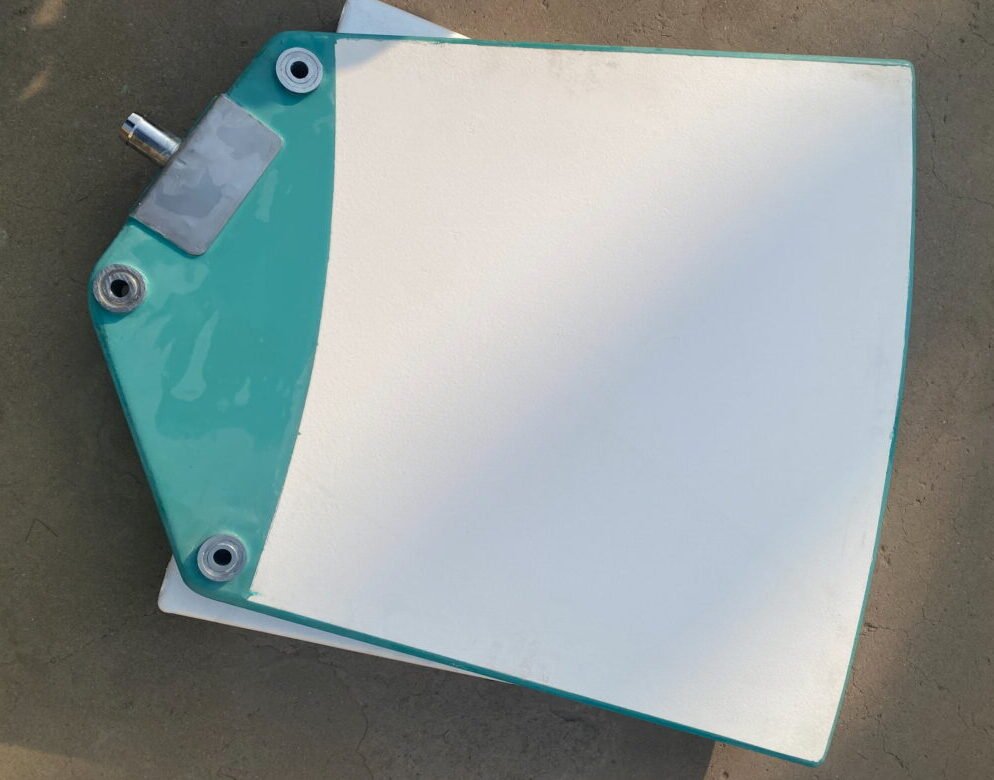
10 m² Disc Sector Plates
Designed for large-format vacuum ceramic disc filter installations processing high-tonnage iron ore concentrate. The monolithic water-cast construction is essential at this scale -- larger plates carry proportionally greater gravitational loads, making structural homogeneity critical to preventing base fracture.
Technical specifications
- Disc area
- 10 m² per disc
- Pore size
- 1.5 - 2.5 μm
- Solid recovery
- ≥ 99.5%
- Structure
- Monolithic cast -- no bond lines
- Material
- High-purity Al₂O₃ ceramic
- Acid resistance
- Oxalic acid · HCl compatible
- Application
- Iron ore concentrate dewatering

4 m² - 6 m² Disc Standard Sector Plates
The standard sector plate series covers the most widely deployed disc filter configurations in iron ore concentrators. Engineered with the same monolithic casting and integral sintering technology as the large-disc series, these plates deliver identical structural and separation performance in compact and mid-scale installations.
Technical specifications
- Disc area range
- 4 m² - 6 m² per disc
- Pore size
- 1.5 - 2.5 μm
- Solid recovery
- ≥ 99.5%
- Structure
- Monolithic cast -- no bond lines
- Material
- High-purity Al₂O₃ ceramic
- Acid resistance
- Oxalic acid · HCl compatible
- Application
- Iron ore concentrate dewatering
Custom configurations available
Non-standard disc sizes, sector geometries and alternative pore specifications can be developed from customer drawings or samples. Our engineering team will assess compatibility and recommend the optimal plate configuration for your specific iron ore circuit.
Operational outcomes
What our plates deliver in iron ore operations
Zero
Base fracture incidents
Monolithic structure eliminates the structural failure mode responsible for disc seizure
≥ 99.5%
Solid phase recovery
Precision micropore membrane captures iron ore microfines that bypass conventional plates
Direct
Process water reuse
Clear filtrate meets quality threshold for direct recirculation -- reducing fresh water consumption
Full
Acid-wash cycle durability
Integral sintered structure survives repeated oxalic acid and HCl cleaning -- no delamination, no degradation
Iron ore filtration engineering
Experiencing base fracture or filtrate quality issues in your iron ore circuit?
Share your machine model, disc size and current failure mode. Our engineering team will recommend the correct plate specification and provide a detailed technical proposal -- including dimensional drawings and expected performance data for your specific ore characteristics.
- Machine model and disc area (we support all vacuum ceramic disc filter types)
- Current plate dimensions or failed plate sample (for reverse engineering)
- Iron ore feed characteristics and current moisture content targets